
Periodontitis (Gum Disease) - what is it and how does it develop?
Periodontitis, also known as gum disease, occurs when the attachment between the tooth and the jawbone is lost, causing the tooth to become loose. This happens because bacteria in plaque are allowed to remain undisturbed on the teeth for longer periods of time and become established. Plaque can become mineralized by saliva, forming tartar and attracting more bacteria that irritate the tooth's supporting tissues. Over time, the process can worsen.
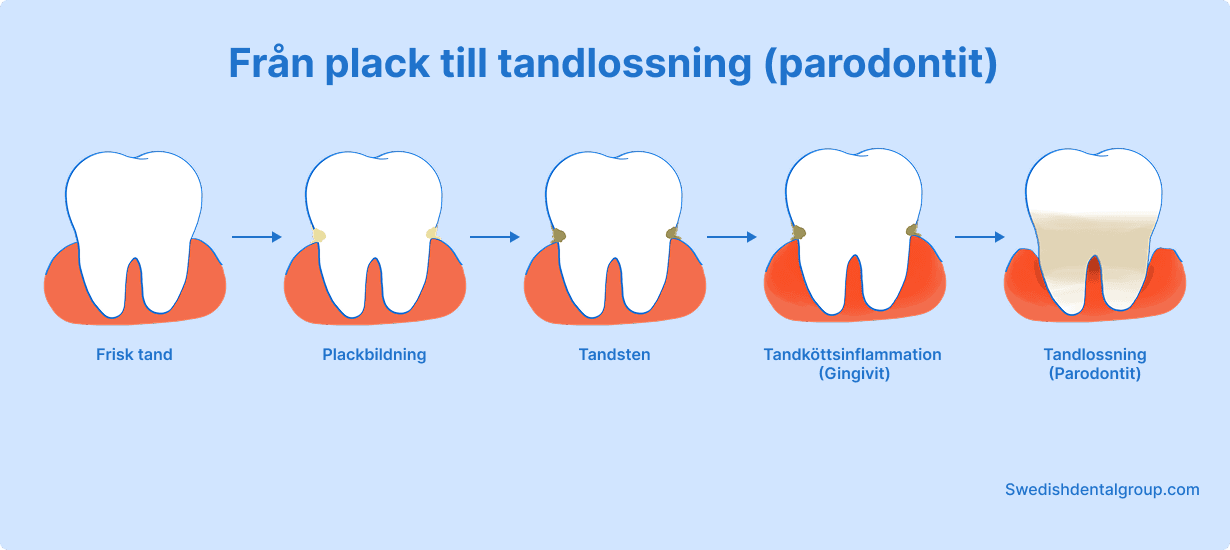
To gain a better understanding of how periodontitis actually works, we can take a closer look at the individual stages of the process – from plaque to tooth loss.
The bacteria found on tooth surfaces, the gums and the surfaces of the oral mucosa are most often facultatively aerobic bacteria, meaning that they can survive both with and without oxygen. Bacteria living in the gum pocket are bacteria that can survive without oxygen, known as anaerobic bacteria. These anaerobic bacteria are strongly associated with gum disease, gingivitis and bad breath.
For tooth loss to occur, the supporting tissues around the tooth must break down. These supporting tissues consist of the gums, jawbone and periodontal ligament, which contains collagen fibers that connect the tooth to the jawbone.
The process from plaque to tartar & gingivitis to periodontitis
Plaque is a film consisting of components from saliva, bacteria and carbohydrates from food that develops on your teeth every day. Plaque can become mineralized and attract bacteria, eventually forming tartar.
Tartar contains bacteria that are encapsulated and inactive, but bacteria generally have a high affinity for one another, meaning that new bacteria can more easily attach to tartar. Because tartar has a rough surface, bacteria can attach to it very easily. As a result, tartar and the bacteria associated with it can accumulate rapidly once tartar has established itself.
Tartar can be divided into salivary calculus and exudate calculus, depending on where it forms. If it forms in the mouth rather than inside the gum pocket, it is referred to as salivary calculus. If it forms inside the gum pocket, where gingival exudate mineralizes plaque, it is instead referred to as exudate calculus.
The first sign that all plaque has not been removed through daily toothbrushing is that the gums may become irritated, red and swollen. This is called gingivitis, or inflammation of the gums.
When gingivitis continues for a longer period of time, nearby tissues, including the periodontal ligament and jawbone, can also begin to break down. As the periodontium is progressively destroyed and the supporting tissues slowly disappear, the affected tooth may begin to feel loose. The gums may also recede, which can expose the tooth root.
As inflammation continues, the gum pocket can become deeper, allowing bacteria and tartar to move further down into the pocket. Tartar can form further down along the tooth root, causing the inflammation to spread progressively deeper over time. Eventually, very little supporting tissue may remain around the tooth, and the tooth may need to be removed if it can no longer be saved.
In depth
How do bacteria contribute to tissue destruction?
Some bacteria produce proteolytic enzymes that can break down the supporting tissues around the tooth. Examples of these enzymes include collagenase, trypsin-like enzymes and phosphatase. These primarily affect the collagen fibers that connect the tooth to the jawbone.
Bacteria can also contribute to tissue destruction by producing tissue-irritating toxins such as leukotoxin, butyric acid, hydrogen sulfide and ammonia. Some toxins can also inhibit fibroblasts, which can reduce the rebuilding of collagen found in the periodontal ligament.
When tissue irritation occurs in the periodontal ligament, various inflammatory signaling substances, also known as cytokines, are released. These include prostaglandin E2, interleukin-1 beta, interleukin-6 and TNF-alpha. These substances contribute to the breakdown of the surrounding jawbone.
Smoking affects periodontitis (gum disease)
Smoking affects both plaque and bone destruction. Studies have shown that smokers have a 2.5–6 times higher risk of developing periodontitis compared with non-smokers.
Smoking constricts the blood vessels in the gums, reducing the supply of oxygen to areas such as the gum pocket and resulting in poorer blood circulation. This can mask inflammation even when it is present, because the gums may bleed less when a person smokes.
The amount of free radicals increases when smoking and continues to increase with prolonged exposure. These are highly reactive molecules that, at higher levels, can cause oxidative stress, damaging cells and tissues and increasing inflammation. As a result, smokers may experience a stronger inflammatory response in connection with periodontitis.
Smokers also tend to have poorer healing capacity than non-smokers. Nicotine negatively affects cells such as fibroblasts, which play an important role in healing and tissue regeneration, making the healing process slower.
Pregnancy, gingivitis, periodontitis - what should you consider?
During pregnancy, levels of the hormones estrogen and progesterone increase. Progesterone helps maintain pregnancy but can also contribute to increased vascular proliferation and vasodilation in mucous membranes, including the gums.
As a result, the gums can become more swollen, bleed more easily and respond more strongly to inflammation. The elevated hormone levels can also create a more favorable environment for periodontal bacteria. Similar situations can occur during puberty and throughout the menstrual cycle.
Good oral hygiene is therefore particularly important during pregnancy, breastfeeding, puberty and menstruation because elevated hormone levels can increase the risk of both gingivitis and periodontitis.
If the supporting tissues are being affected so aggressively, why doesn't it hurt?
Because gum disease usually develops slowly and bone destruction occurs over a long period of time, the symptoms can go unnoticed. Unlike toothache, where inflammation of the dental pulp can cause significant pain, periodontitis does not always produce the same acute pain response.
Is it genetic?
Yes, genetic factors influence how the immune system responds to bacterial irritation. However, many factors are environmental and can be influenced by the individual. Environmental factors therefore play an important role in the development of periodontitis.
In depth
Diseases that affect periodontitis (gum disease)
Diseases associated with a defective leukocyte defense can negatively affect the number and function of PMN cells (polymorphonuclear leukocytes; neutrophils, eosinophils and basophils). This can result in severe bone loss and frequent ulcerations.
Examples of such diseases include agranulocytosis, neutropenia, Lazy-leukocyte syndrome, ulcerative colitis, Crohn's disease and diabetes.
How do you get rid of tartar and prevent periodontitis?
Tartar needs to be professionally removed by either a dentist or dental hygienist. Treatment involves mechanical cleaning using instruments to remove tartar and can often be supplemented with ultrasonic instruments to loosen and remove tartar. The teeth can then be polished with a fine polishing material to remove any remaining discoloration.
Ultrasonic treatment can also help reduce certain bacteria in the gum pocket, creating better conditions for a new bacterial flora to establish itself.
In some cases, surgery may be necessary to remove tartar that is difficult to access in very deep gum pockets. In other cases, certain teeth may need to be removed if they can no longer be saved.
After all tartar has been removed, it is extremely important to maintain good oral hygiene through thorough toothbrushing and daily cleaning between the teeth. In some cases, supportive treatment with products containing chlorhexidine gluconate may also be indicated, such as Hexident or Corsodyl mouthwash.
Welcome to Swedish Dental Group!
At Swedish Dental Group, you can work together with experienced dentists to create a customized treatment plan covering treatment, cost, time requirements and follow-up home care. Welcome to us for a visit!